Loading...

Bands // p 14 of 34

Darren's favorite bands for his Song Of The Day choices.
507 Bands
Hossam Ramzy

Hossam Ramzy

Hossam Ramzy (Arabic: حسام رمزي‎; born in Cairo, Egypt) is an Egyptian percussionist and composer. He has worked with Western artists like Jimmy Page and Robert Plant as well as with Arabic music artists like Rachid Taha and Khaled.

Ramzy was born into a wealthy Cairo family. He began playing the darbuka and tabla at an early age. He moved to Saudi Arabia for a time and learned traditional Bedouin music styles. In the 1970s he moved to London and began playing with saxophonist Andy Sheppard. His collaborations with jazz musicians earned him the nickname "The Sultan of Swing". In 1989 he worked with Peter Gabriel on the soundtrack to Martin Scorsese's The Last Temptation of Christ. This brought him to the attention of artists such as Frank Asher and the Gipsy Kings.

In 1994 he returned to his roots and formed a ten piece Egyptian ensemble that performed on the album No Quarter: Jimmy Page and Robert Plant Unledded. Ramzy and his ensemble also gained exposure by touring with Plant and Page throughout 1995 in support of their album. The next year Ramzy released the first of three collaborations with English arranger Phil Thornton, Eternal Egypt. The success of Eternal Egypt's blend of Arabic music prompted the follow up albums Immortal Egypt and Enchanted Egypt. In 1996, Hossam and his percussion section played with Big Country in Dingwalls club. From this event was recorded "Eclectic". In 1998, he performed with Rachid Taha, Khaled and Faudel at their 1,2,3 Soleils concert and backed Khaled again for the Claude Challe album Flying Carpet.

In 2000, Jay-Z sampled his version of "Khosara" for "Big Pimpin'". After 2000 Ramzy increasingly began to work arranging music for pop stars. In 2005 he arranged some songs for Ricky Martin's album Life and he worked with Shakira on her album She Wolf. He also contributed two songs to the soundtrack for the film Prince of Persia and one to the soundtrack for Conan The Barbarian.

His latest album titled Rock the Tabla released on 30 August 2011. It features Indian composer A.R. Rahman, Omar Faruk Tekbilek, Manu Katché and Billy Cobham.

Source Wikipedia

 'Fallahi'

'Fallahi'
Friday, August 30, 2019

Music   Spotify    YouTube

Howlin' Wolf

Howlin' Wolf

Chester Arthur Burnett (June 10, 1910 – January 10, 1976), known as Howlin' Wolf, was a Chicago blues singer, guitarist, and harmonica player. Originally from Mississippi, he moved to Chicago in adulthood and became successful, forming a rivalry with fellow bluesman Muddy Waters. With a booming voice and imposing physical presence, he is one of the best-known Chicago blues artists.

The musician and critic Cub Koda noted, "no one could match Howlin' Wolf for the singular ability to rock the house down to the foundation while simultaneously scaring its patrons out of its wits." Producer Sam Phillips recalled, "When I heard Howlin' Wolf, I said, 'This is for me. This is where the soul of man never dies.'" Several of his songs, including "Smokestack Lightnin'", "Killing Floor" and "Spoonful", have become blues and blues rock standards. In 2011, Rolling Stone magazine ranked him number 54 on its list of the "100 Greatest Artists of All Time".

Musical Career

1930s and 1940s
In 1930, Burnett met Charley Patton, the most popular bluesman in the Mississippi Delta at the time. He would listen to Patton play nightly from outside a nearby juke joint. There he remembered Patton playing "Pony Blues", "High Water Everywhere", "A Spoonful Blues", and "Banty Rooster Blues". The two became acquainted, and soon Patton was teaching him guitar. Burnett recalled that "the first piece I ever played in my life was ... a tune about hook up my pony and saddle up my black mare"—Patton's "Pony Blues". He also learned about showmanship from Patton: "When he played his guitar, he would turn it over backwards and forwards, and throw it around over his shoulders, between his legs, throw it up in the sky". Burnett would perform the guitar tricks he learned from Patton for the rest of his life. He played with Patton often in small Delta communities.

Burnett was influenced by other popular blues performers of the time, including the Mississippi Sheiks, Blind Lemon Jefferson, Ma Rainey, Lonnie Johnson, Tampa Red, Blind Blake, and Tommy Johnson. Two of the earliest songs he mastered were Jefferson's "Match Box Blues" and Leroy Carr's "How Long, How Long Blues". The country singer Jimmie Rodgers was also an influence. Burnett tried to emulate Rodgers's "blue yodel" but found that his efforts sounded more like a growl or a howl: "I couldn't do no yodelin', so I turned to howlin'. And it's done me just fine". His harmonica playing was modeled after that of Sonny Boy Williamson II, who taught him how to play when Burnett moved to Parkin, Arkansas, in 1933.

During the 1930s, Burnett performed in the South as a solo performer and with numerous blues musicians, including Floyd Jones, Johnny Shines, Honeyboy Edwards, Sonny Boy Williamson II, Robert Johnson, Robert Lockwood, Jr., Willie Brown, Son House and Willie Johnson. By the end of the decade, he was a fixture in clubs, with a harmonica and an early electric guitar.

On April 9, 1941, he was inducted into the U.S. Army and was stationed at several bases around the country. Finding it difficult to adjust to military life, he was discharged on November 3, 1943. He returned to his family, who had recently moved near West Memphis, Arkansas, and helped with the farming while also performing, as he had done in the 1930s, with Floyd Jones and others. In 1948 he formed a band, which included the guitarists Willie Johnson and Matt "Guitar" Murphy, the harmonica player Junior Parker, a pianist remembered only as "Destruction" and the drummer Willie Steele. Radio station KWEM in West Memphis began broadcasting his live performances, and he occasionally sat in with Williamson on KFFA in Helena, Arkansas.

1950s
In 1951, Howlin' Wolf was discovered by A&R man Ike Turner who had him record several songs for both Sam Phillips at Sun Records (which licensed its recordings to Chess Records) and the Bihari brothers at Modern Records. Phillips praised his singing, saying, "God, what it would be worth on film to see the fervour in that man's face when he sang. His eyes would light up, you'd see the veins come out on his neck and, buddy, there was nothing on his mind but that song. He sang with his damn soul." Howlin' Wolf quickly became a local celebrity and began working with a band that included the guitarists Willie Johnson and Pat Hare. His first singles were issued by two different record companies in 1951: "How Many More Years" backed with "Moaning at Midnight", released by Chess Records, and "Riding in the Moonlight" backed with "Moaning at Midnight", released by RPM Records. Later, Leonard Chess was able to secure his contract, and Howlin' Wolf relocated to Chicago in 1952. There he assembled a new band and recruited the Chicagoan Jody Williams from Memphis Slim's band as his first guitarist. Within a year he had persuaded the guitarist Hubert Sumlin to leave Memphis and join him in Chicago; Sumlin's understated solos and surprisingly subtle phrasing perfectly complemented Burnett's huge voice. The lineup of the Howlin' Wolf band changed often over the years. He employed many different guitarists, both on recordings and in live performance, including Willie Johnson, Jody Williams, Lee Cooper, L.D. McGhee, Otis "Big Smokey" Smothers, his brother Little Smokey Smothers, Jimmy Rogers, Freddie Robinson, and Buddy Guy, among others. Burnett was able to attract some of the best musicians available because of his policy, unusual among bandleaders, of paying his musicians well and on time, even including unemployment insurance and Social Security contributions. With the exception of a couple of brief absences in the late 1950s, Sumlin remained a member of the band for the rest of Howlin' Wolf's career and is the guitarist most often associated with the Chicago Howlin' Wolf sound.

Howlin' Wolf had a series of hits with songs written by Willie Dixon, who had been hired by the Chess brothers in 1950 as a songwriter, and during that period the competition between Muddy Waters and Howlin' Wolf was intense. Dixon reported "Every once in a while Wolf would mention the fact that, 'Hey man, you wrote that song for Muddy. How come you won't write me one like that?' But when you'd write for him he wouldn't like it." So, Dixon decided to use reverse psychology on him, by introducing the songs to Wolf as written for Muddy, thus inducing Wolf to accept them.

In the 1950s, Howlin' Wolf had five songs on the Billboard national R&B charts: "Moanin' at Midnight", "How Many More Years", "Who Will Be Next", "Smokestack Lightning", and "I Asked for Water (She Gave Me Gasoline)". His first LP, Moanin' in the Moonlight, was released in 1959. As was standard practice in that era, it was a collection of previously released singles.

1960s and 1970s
In the early 1960s, Howlin' Wolf recorded several songs that became his most famous, despite receiving no radio play: "Wang Dang Doodle", "Back Door Man", "Spoonful", "The Red Rooster" (later known as "Little Red Rooster"), "I Ain't Superstitious", "Goin' Down Slow", and "Killing Floor", many of which were written by Willie Dixon. Several became part of the repertoires of British and American rock groups, who further popularized them. Howlin' Wolf's second compilation album, Howlin' Wolf (often called "the rocking chair album", from its cover illustration), was released in 1962.

During the blues revival in the 1950s and 1960s, black blues musicians found a new audience among white youths, and Howlin' Wolf was among the first to capitalize on it. He toured Europe in 1964 as part of the American Folk Blues Festival, produced by the German promoters Horst Lippmann and Fritz Rau. In 1965, he appeared on the popular television program Shindig! at the insistence of the Rolling Stones, whose recording of "Little Red Rooster" had reached number one in the UK in 1964. In the late 1960s and early 1970s, Howlin' Wolf recorded albums with others, including The Super Super Blues Band, with Bo Diddley and Muddy Waters; The Howlin' Wolf Album, with psychedelic rock and free-jazz musicians like Gene Barge, Pete Cosey, Roland Faulkner, Morris Jennings, Louis Satterfield, Charles Stepney and Phil Upchurch; and The London Howlin' Wolf Sessions, accompanied by the British rock musicians Eric Clapton, Steve Winwood, Ian Stewart, Bill Wyman, Charlie Watts and others.

The Howlin' Wolf Album, like rival bluesman Muddy Waters's album Electric Mud, was designed to appeal to the hippie audience. The album had an attention-getting cover: large black letters on a white background proclaiming "This is Howlin' Wolf's new album. He doesn't like it. He didn't like his electric guitar at first either." The album cover may have contributed to its poor sales. Chess co-founder Leonard Chess admitted that the cover was a bad idea, saying, "I guess negativity isn't a good way to sell records. Who wants to hear that a musician doesn't like his own music?"

The London Howlin' Wolf Sessions, like Muddy Waters's London album, proved more successful with British audiences than American.

Wolf's last album was 1973's The Back Door Wolf. Entirely composed of new material, it was recorded with musicians who regularly backed him on stage, including Hubert Sumlin, Detroit Junior, Andrew "Blueblood" McMahon, Chico Chism, Lafayette "Shorty" Gilbert and the bandleader Eddie Shaw. The album is shorter (a little more than 35 minutes) than any other he recorded, as a result of his declining health.

Source Wikipedia

 'Moanin' at Midnight'

'Moanin' at Midnight'
Thursday, January 14, 2021

Music   Spotify    YouTube

 'Shake For Me'

'Shake For Me'
Friday, May 8, 2020

Music   Spotify    YouTube

Ian Dury

Ian Dury

Ian Robins Dury (12 May 1942 – 27 March 2000) was an English singer-songwriter and actor who rose to fame during the late 1970s, during the punk and new wave era of rock music. He was the lead singer of Ian Dury and the Blockheads and before that of Kilburn and the High Roads.

Dury was born at his parents' home at 43 Weald Rise, Harrow Weald, Middlesex (though he often pretended that he had been born in Upminster, Essex, which all but one of his obituaries in the UK national press stated as fact). His father, William George Dury (born 23 September 1905, Southborough, Kent; died 25 February 1968), was a bus driver and former boxer, while his mother Margaret (known as "Peggy", born Margaret Cuthbertson Walker, 17 April 1910, Rochdale, Lancashire; d. January 1995) was a health visitor, the daughter of a Cornish doctor and the granddaughter of an Irish landowner.

William Dury trained with Rolls-Royce to be a chauffeur, and was then absent for long periods, so Peggy Dury took Ian to stay with her parents in Cornwall. After the Second World War, the family moved to Switzerland, where his father chauffeured for a millionaire and the Western European Union. In 1946 Peggy brought Ian back to England and they stayed with her sister, Mary, a doctor in Cranham, a small village in Essex. Although he saw his father on visits, they never lived together again.

At the age of seven, he contracted polio, most likely, he believed, from a swimming pool at Southend on Sea during the 1949 polio epidemic. After six weeks in a full plaster cast in the Royal Cornwall Infirmary, Truro, he was moved to Black Notley Hospital, Braintree, Essex, where he spent a year and a half before going to Chailey Heritage Craft School, East Sussex, in 1951.

Source Wikipedia
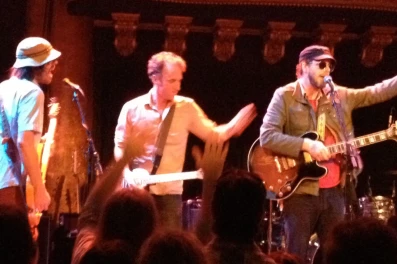
 'Sex & Drugs & Rock & Roll'

'Sex & Drugs & Rock & Roll'
Wednesday, March 27, 2019

Music   Spotify    YouTube

Isobel Campbell & Mark Lanegan

Isobel Campbell & Mark Lanegan

The second album from odd-couple collaborators Isobel Campbell and Mark Lanegan feels a touch phony but hardly phoned in. He's got the voice, she's got the songs, and together they take us back to the late 60s.

It was another surprising detour in a career composed almost exclusively of detours: Isobel Campbell, former Belle & Sebastian member and sometime solo act, teamed with Mark Lanegan, taciturn former Screaming Trees singer and serial collaborator. With the release of their Ballad of the Broken Seas, the "Beauty and the Beast" lines came fast and furious. So did the Nancy and Lee comparisons, which were probably welcome. The pairing of Lanegan and Campbell may have come as a shock to fans of the latter (and maybe even the former) but the music itself was less than revelatory. Indeed, the Lee Hazelwood/Nancy Sinatra template is iconic for a reason, and to borrow it means to risk imitating them. It also means treading closely to Leonard Cohen, Scott Walker, or any other somber, late-1960s orchestral pop act.

Still, the results were beautiful and brooding, with Campbell's songwriting significantly enhanced by this very specific setting. Sequels, however, are inherently built on familiarity and a sequel to the solid yet by-the-books Ballad of the Broken Seas could be as problematic as the Hollywood models are. Yet while Sunday at Devil Dirt may be more of the same (with glimpses of Tom Waits' junkyard blues tossed in to good effect), Campbell and Lanegan were never out to do anything different. Once again, melancholy, minor-key folk melodies, and bits of spy-theme and spaghetti-western cool color the album, typically enhanced by only the classiest of accompaniment-- upright bass, strings, brushed drums, twangy electric guitars, and other chamber-pop mainstays. And once again, Campbell works better as a supporting player on her own record than as a leader, cooing and chiming away in the background. Sure, she provides most of the songwriting, but it's Lanegan who provides the gravitas.

Fortunately, Campbell seems to realize her place here as writer and arranger first and foremost, generally ceding the spotlight to Lanegan on the likes of the bleak (of course) "The Raven" and "Back Burner", the somewhat lighter country-blues of "Salvation" and "Sally Don't You Cry", and the spare folk of "Something to Believe". Compared to Lanegan, Campbell sounds thin singing lead on "Shot Gun Blues" or as duet partner on "Who Built the Road" and "The Flame That Burns". Her vocals are almost like post-production special effects.

In a lot of ways that's what makes the disc such a good, breezy listen. Campbell's turn on "Come On Over (Turn Me On)" aims for sultry yet can't get beyond sweet and innocent; in Lanegan, however, she's found a substitute singer that's a perfect match for the strength of her compositions, a rumbling, grumbling vessel through which to channel her songs, themselves channeling the vibe of a lost but not forgotten time of smoky bars, scratchy jukeboxes, convertibles, open roads, broken hearts, cheap motels, and cheaper thrills. It's a bit like a dust-specked and flickering faux Super-8 road trip reel, with Campbell manning the camera and sitting in the director's chair and Lanegan glowering away in the uncomfortable glare of the sun.

Source pitchfork.com

 'The Flame That Burns'

'The Flame That Burns'
Tuesday, July 24, 2018

Music   Spotify    YouTube

Israel Nash

Israel Nash

Texas’ genre-bending rock ‘n’ roller Israel Nash presents his latest long play, Lifted. It is a modern day hippie-spiritual, a tonic for those needing to put aside the mess of the daily grind. With luscious beds of strings, horns and well adorned towering walls of sound, Lifted finds Nash continuing his tradition of creating a sonic experience of feeling that is at once both vast and intimate - soaring and untamed at times, placid and sincerely personal at others.

Originally from the Ozarks of Missouri, Israel Nash has made his home in Dripping Springs, Texas for the greater part of a decade. There, on his ranch with sweeping views of the Texas Hill Country, the tall, hirsute mountain man

built his own studio; a Quonset hut structure he’s dubbed Plum Creek Sound. The studio became a sanctuary, a creative outlet where Nash reached a meditative state of escapism, which ultimately became the inspiration behind Lifted. The creative process of writing, recording and producing Lifted allowed Nash to leave his own downhearted feelings about the political landscape of the recent elections and the deeper queries of purpose and life that supersede the material world. Nash wrote and recorded Lifted with the intention of achieving a sonic experience that will elevate the listener - that the feeling of peace, love and happiness which saturates the words and music can provide the same escape he achieved while creating the LP.

Being able to finally use Plum Creek Sound to its utmost, Nash incorporated found sounds and field recordings from his Texas ranch to create a setting of the sounds that represent his Hill Country life. Drums played in rain collection tanks, water rushing against the limestone, frogs and crickets in their habitats, and even a curious, yet guarded rattlesnake, all appear throughout the record. Inspired by methods pioneered by John Cage, Nash also randomized sounds and music and rearranged them according to the I Ching (The Book of Changes). Utilizing these recording and tracking techniques help create a sonic and very present picture of Nash’s home and his life. Accompanied by his longtime band, with arrangements by Jesse Chandler (Mercury Rev, Midlake), horns by members of Austin’s cumbia/funk compadre’s Grupo Fantasma, and strings from Kelsey Wilson and Sadie Wolf of indie pop’s Wild Child, Nash, alongside co- producer and engineer Ted Young (Kurt Vile, The Rolling Stones), presents an album that soars as a masterwork of American roots songs, meticulously crafted and gently sprinkled with life meaning and multi-hued rock and psychedelia.

“It’s all about finding, searching for little sparks of inspiration. It may be a sound, a groove, a color, or even an object. Old things are inspiring. Whatever it is, when you find it, it spreads like a conflagration that is out of your control. It doesn’t matter if you’re making a record or living your life, find these inspirations with a vigil eye and watch them change both you and your world.”

Lifted opens with an extended instrumental introduction, preparing the listener to get comfortable and settle in for the journey ahead, before blossoming into “Rolling On.” It’s a manifesto, a hearty breath of rock goodness, clean air for all that follows. A sing-along anthem of urgency, encouraging one to let go of yesterday and spring from the traps of worry in order to move onward and upward - rolling on, right here and right now.

“It was a simple message to myself, to not get stuck in thinking and the past. It’s too easy for us to worry about pretty much everything. I had been down and low for a bit and really had to sing and write those feelings away, give them to the moment and find a better self in the end.”

What follows is an Americana-bred opus without equal. From the familial harmonies of “Sweet Springs,” recalling the Beach Boys at their most joyous (almost all performed by Nash himself), to the country rock riffage of “Lucky Ones” and “SpiritFalls” conjuring up that much needed healing, to the album ending “Golden Fleeces,” a sunshine laden song offering up sweet relief from those troubles and tying the preceding up with a sense of lightness and much needed joy.

By immersing oneself in Lifted, one can see Nash succeeds in a way that’s exquisite yet spiritually satisfying. Nash welcomes you to join him on his uplifting path - one he’s taken throughout his career, now continuing on a higher, imaginative plane. May your ears be blessed and may your soul be lifted.

Source IsraelNash.com

 'LA Lately'

'LA Lately'
Tuesday, September 7, 2021

Music   Spotify    YouTube

 'Rain Plans'

'Rain Plans'
Friday, April 17, 2020

Music   Spotify    YouTube

J. Tillman

J. Tillman

Joshua Michael Tillman (born May 3, 1981), also known as Father John Misty and previously J. Tillman, is an American singer-songwriter, musician, and record producer.

Maintaining a steady output of solo recordings since 2004, Tillman had been a member of or toured with Demon Hunter, Saxon Shore, Fleet Foxes, Jeffertitti's Nile, Pearly Gate Music, Siberian, Har Mar Superstar, Poor Moon, Low Hums, Jonathan Wilson, and has toured extensively with Pacific Northwest artists Damien Jurado, Jesse Sykes, and David Bazan.

He has also made contributions to albums by popular artists, including Beyoncé, Lady Gaga, and Kid Cudi, and has produced one album for Matthew Daniel Siskin, known as Gambles.

Source Wikipedia

 'Vessels'

'Vessels'
Friday, June 14, 2019

Music   Spotify    YouTube

J.J. Cale

J.J. Cale

John Weldon "J. J." Cale (December 5, 1938 – July 26, 2013) was an American guitarist, singer, and songwriter. Though he avoided the limelight, his influence as a musical artist has been widely acknowledged by figures such as Mark Knopfler, Neil Young and Eric Clapton, who described him as "one of the most important artists in the history of rock". He is considered to be one of the originators of the Tulsa Sound, a loose genre drawing on blues, rockabilly, country, and jazz.

Many songs written by Cale have been recorded by other acts, including "After Midnight" and "Cocaine" by Eric Clapton; "Call Me the Breeze" by Lynyrd Skynyrd, John Mayer, Johnny Cash, and Bobby Bare; "Clyde" by Waylon Jennings and Dr. Hook; "I Got The Same Old Blues" by Captain Beefheart, Lynyrd Skynyrd, Freddie King, and Bryan Ferry; "Travelin' Light" and "Ride Me High" by Widespread Panic; and "Magnolia" by Poco, Pat Travers, Beck, Lucinda Williams, Iron & Wine, José Feliciano, Ben Bridwell, John Mayer with Eric Clapton, Joan Shelley, and Sadie Johnson; as well as “Bringing It Back” covered by Kansas.

In 2008, Cale, along with Clapton, received a Grammy Award for their album The Road to Escondido.

Source Wikipedia

 'Tijuana'

'Tijuana'
Friday, July 9, 2021

Music   Spotify    YouTube

 'Since You Said Goodbye'

'Since You Said Goodbye'
Monday, January 25, 2021

Music   Spotify    YouTube

 'The Woman That Got Away'

'The Woman That Got Away'
Sunday, September 22, 2019

Music   Spotify    YouTube

 'Crazy Mama'

'Crazy Mama'
Saturday, October 27, 2018

Music   Spotify    YouTube

Jack DeJohnette

Jack DeJohnette

Jack DeJohnette (born August 9, 1942) is an American jazz drummer, pianist, and composer.

An important figure of the fusion era of jazz, DeJohnette is one of the most influential jazz drummers of the 20th century, given his extensive work as leader and sideman for musicians including Charles Lloyd, Freddie Hubbard, Keith Jarrett, Bill Evans, John Abercrombie, Alice Coltrane, Sonny Rollins, Miles Davis, Joe Henderson, Michael Brecker, Herbie Hancock and John Scofield. He was inducted into the Modern Drummer Hall of Fame in 2007.

Early life and musical beginnings
DeJohnette was born in Chicago, Illinois. He began his musical career as a pianist, studying from age four and first playing professionally at age fourteen He later switched focus to the drums. DeJohnette credits his uncle, Roy I. Wood Sr., a Chicago disc jockey and vice president of the National Network of Black Broadcasters, as his inspiration to play music.

DeJohnette played R&B, hard bop, and avant-garde music in Chicago. He led his own groups in addition to playing with Richard Abrams, Roscoe Mitchell and other eventual core members of the Association for the Advancement of Creative Musicians (founded in 1965). He also occasionally performed with Sun Ra and his Arkestra (and later in New York as well). In the early 1960s, DeJohnette had the opportunity to sit in for three tunes with John Coltrane and his quintet, an early foray into playing with big-name jazz musicians.

In 1966 DeJohnette moved to New York City, where he became a member of the Charles Lloyd Quartet. A band that recognized the potential influence of rock and roll on jazz, Lloyd's group was where DeJohnette first encountered pianist Keith Jarrett, who would work extensively with him throughout his career. However, DeJohnette left the group in early 1968, citing Lloyd's deteriorating, "flat" playing as his main reason for leaving. While Lloyd's band was where he received international recognition for the first time, it was not the only group DeJohnette played with during his early years in New York, as he also worked with groups including Jackie McLean, Abbey Lincoln, Betty Carter, and Bill Evans. DeJohnette joined Evans' trio in 1968, the same year the group headlined the Montreux Jazz Festival and produced the album Bill Evans at the Montreux Jazz Festival. In November 1968 he worked briefly with Stan Getz and his quartet, which led to his first recordings with Miles Davis.

Source Wikipedia

 'Bayou Fever'

'Bayou Fever'
Wednesday, March 10, 2021

Music   Spotify    YouTube

 'Blue'

'Blue'
Monday, November 25, 2019

Music   Spotify    YouTube

Jackpot

Jackpot

American rock band formed in Sacramento, California.

 'She's So Cool'

'She's So Cool'
Wednesday, January 8, 2020

Music   Spotify    YouTube

James Booker

James Booker

James Carroll Booker III (December 17, 1939 – November 8, 1983) was a New Orleans rhythm and blues keyboardist born in New Orleans, Louisiana, United States. Booker's unique style combined rhythm and blues with jazz standards. Musician Dr. John described Booker as "the best black, gay, one-eyed junkie piano genius New Orleans has ever produced." Flamboyant in personality, he was known as "the Black Liberace".

Biography

Early life
Booker was the son and grandson of Baptist ministers, both of whom played the piano. He spent most of his childhood on the Mississippi Gulf Coast, where his father was a church pastor. Booker received a saxophone as a gift from his mother, but he was more interested in the keyboard. He played the organ in his father's churches.

After returning to New Orleans in his early adolescence, Booker attended the Xavier Academy Preparatory School. He learned some elements of his keyboard style from Tuts Washington and Edward Frank. Booker was highly skilled in classical music and played music by Bach and Chopin, among other composers. He also mastered and memorized solos by Erroll Garner and Liberace. His performances combined elements of stride, blues, gospel and Latin piano styles.

Source Wikipedia

 'I'll Be Seeing You'

'I'll Be Seeing You'
Tuesday, August 25, 2020

Music   Spotify    YouTube

James Brown

James Brown

James Joseph Brown (May 3, 1933 – December 25, 2006) was an American singer-songwriter, dancer, musician, record producer and bandleader. A progenitor of funk music and a major figure of 20th-century music and dance, he is often referred to as the "Godfather of Soul". In a career that lasted 50 years, he influenced the development of several music genres.

Brown began his career as a gospel singer in Toccoa, Georgia. He joined an R&B vocal group, the Gospel Starlighters (which later evolved into the Flames) founded by Bobby Byrd, in which he was the lead singer. First coming to national public attention in the late 1950s as a member of the singing group The Famous Flames with the hit ballads "Please, Please, Please" and "Try Me", Brown built a reputation as a tireless live performer with the Famous Flames and his backing band, sometimes known as the James Brown Band or the James Brown Orchestra. His success peaked in the 1960s with the live album Live at the Apollo and hit singles such as "Papa's Got a Brand New Bag", "I Got You (I Feel Good)" and "It's a Man's Man's Man's World". During the late 1960s he moved from a continuum of blues and gospel-based forms and styles to a profoundly "Africanized" approach to music-making that influenced the development of funk music. By the early 1970s, Brown had fully established the funk sound after the formation of the J.B.s with records such as "Get Up (I Feel Like Being a) Sex Machine" and "The Payback". He also became noted for songs of social commentary, including the 1968 hit "Say It Loud – I'm Black and I'm Proud". Brown continued to perform and record until his death from pneumonia in 2006.

Brown recorded 17 singles that reached number one on the Billboard R&B charts. He also holds the record for the most singles listed on the Billboard Hot 100 chart which did not reach number one. Brown has received honors from many institutions, including inductions into the Rock and Roll Hall of Fame and Songwriters Hall of Fame. In Joel Whitburn's analysis of the Billboard R&B charts from 1942 to 2010, James Brown is ranked as number one in The Top 500 Artists. He is ranked seventh on the music magazine Rolling Stone's list of its 100 greatest artists of all time. Rolling Stone has also cited Brown as the most sampled artist of all time.

Source Wikipedia

 'Lost Someone'

'Lost Someone'
Monday, November 16, 2020

Music   Spotify    YouTube

 'Out Of The Blue'

'Out Of The Blue'
Friday, December 14, 2018

Music   Spotify    YouTube

James Shook

James Shook

The Utah vortex got me,” says James Shook, one of several fine Salt Lake musicians we’d lost to the lush Portland, Ore., scene. During the ’90s, Shook was busy on the Salt Lake music scene with his bands Loose and James Shook & the Resolutions until 1999, when he left for the reason everybody leaves: “Portland has much more music industry for its size than does Salt Lake City, so it seemed the natural next step for what I was trying to do.”

He’s back now, due to circumstances beyond his control.

Living and working in Portland, Shook was planning to return to Logan to spend three months finishing a solo album before relocating to Los Angeles. But two months into the recording, he ate concrete in a skateboard park, breaking both arms and partially paralyzing the fingers in his left hand. “It took about six months, two surgeries, a steel plate and 12 screws to get everything working again,” he says, adding the medical bills forced him to stay in Utah. This would be strange serendipity.

He was born here but moved around during his childhood (L.A., Hawaii, Idaho, back here—to Logan). He wrote his first song on guitar when he was six, “no chords, just open strings.” He says he was expected to be a visual artist, so he didn’t seriously pursue music until he was 18, when he spent a summer in Alaska with a friend who owned a guitar. “I just started playing it all the time. The rest is sort of a blur.”

A blur, perhaps, because when he returned to Salt Lake to form the jammy Loose, the band rose quickly on the scene, drawing fat crowds at the Holy Cow (now the Urban Lounge) and the Zephyr Club. They released an album, Fluid, and toured for a year—to the tune of 180 shows—until “we just burned ourselves out and split up.”

After Loose, Shook went solo acoustic and played bass with Mighty Dave & His Crescent City Thunder and formed an embryonic version of the R& -rock-reggae Resolutions. About that time the Jackmormons took Shook on the road for 18 months, first as their merchandise handler, then their opening act, “which turned into me playing with them every night until we were talking about me joining up.” He didn’t, but he did make the move to Portland and lured more Salt Lake players there in order to give the Resolutions a serious go.

The Resolutions released one album, Fidelity, a result of Shook having an old analog eight-track machine lying around. Since the band never really had a solid lineup, the album featured “lots of different players” (including Jameson Wilkins of J.W. Blackout and Jed Keipp of Jebu) but with Shook handling many of the instruments himself. He put together a touring lineup and went out for six months, with basically the same result as with Loose. Six months later, he was doing solo acoustic gigs in Portland.

Which brings us to the fortuitous fracture, the bills from which kept Shook in Salt Lake. While recovering, he considered abandoning music, but for bedroom jamming. He still loved playing, but he’d lost the drive to “make it” and was “disappointed at how much of my life I’d let slip by trying to catch success.” He eventually “relaxed” and hooked up with drummer Nate Smith and bassist Mark McKnight, neither of whom he’d played with previously. The new band, which begins gigging this month, is called Jin Shen, which translates roughly to “internal power of spirit.” The group is very much like the Resolutions’ multifarious sound, only more laidback. Like Shook, post-priority shift.

“It’s important for me to write songs that are honest,” he says, which may be the extent of his goals for Jin Shen. “Maybe I’m not sure.” He’s content with his day-to-day life here—studying martial arts five days a week—and is trying to avoid letting the business or social aspects of a band interfere with or run his life, “because they will if you let them. I’ll wait and see what comes to me as a result of investing in just what I love about playing music. If the right opportunity comes along, well, we’ll see.”

By Randy Harward on 6/11/2007

Source Salt Lake City Weekly

 'Cure'

'Cure'
Monday, June 10, 2019

Music   Spotify    YouTube

Janet Kay

Janet Kay

Janet Kay (born 17 January 1958) is an English actor and vocalist, best known for her 1979 lovers rock hit "Silly Games".

Biography

Janet Kay Bogle was born in Willesden, North West London. She was discovered singing impromptu at a rehearsal studio by Tony "Gad" Robinson, the keyboardist from Aswad, who recommended Kay to Alton Ellis. The Jamaican-born Ellis, a successful rocksteady vocalist, had relocated permanently to London, where he continued to be involved with reggae music and was looking for a female vocalist to record a reggae cover of Minnie Riperton's song "Lovin' You". In 1978 Kay recorded "I Do Love You" and "That's What Friends Are For". The single "Silly Games", written and produced by Dennis Bovell, was released in 1979 and became a hit across Europe, reaching No. 2 in the UK Singles Chart. The chart success of "Silly Games" led to Kay appearing on Top of the Pops, then the BBC's flagship music programme. She played the character Angel in the UK sitcom No Problem!, created by the Black Theatre Co-operative (now NitroBeat) and broadcast on Channel 4 (1983–85). While on the programme, she enjoyed a further club hit with "Eternally Grateful" in 1984, which also reached the UK top 100.

Kay has recorded, and co-produced her seventh album for Sony Music Japan. It was released on 18 June 2003, and is entitled Lovin' You … More. The popularity of the song "Lovin' You" in Japan is so strong that she was asked to record it again for this album (for the third time). That version was produced by Omar.

"Silly Games" first hit the UK charts in 1979, and appeared again in 1990 as a re-recording, billed as by Lindy Layton featuring Janet Kay, which reached No. 22. A remix version of Kay's original recording spent three weeks in the UK Singles Chart, peaking at No. 62.

Kay is credited as producer on "Missing You", recorded by Aswad.

She was a founding member of BiBi Crew, Britain's first theatre troupe made up entirely of Black women.

Kay was included on the 2003 list of "100 Great Black Britons".

Source Wikipedia

 'Silly Games'

'Silly Games'
Saturday, January 23, 2021

Music   Spotify    YouTube

Jay William Henderson

Jay William Henderson

Jay William Henderson is a singer songwriter from Salt Lake City, UT. Former front man and primary song writer for 'Band Of Annuals' Jay struck out on his solo career with his release of 'The Sun Will Burn Our Eyes'. Nominated by Magnet Magazine as one of the best Indie Folk albums of 2012.

Source bandcamp.com

 'Flame'

'Flame'
Tuesday, February 4, 2020

Music   Spotify    YouTube

Bands, p 14 of 34

FOLLOW